

5 Ways Gukesh and Vaishali Are Transforming Indian Chess
Introduction
For decades, Indian chess was synonymous with one name: Viswanathan Anand. Today, it represents a full-scale revolution. Walk into any chess academy in Bangalore, Chennai, Hyderabad, or Mumbai, and you’ll hear children dissecting opening novelties and Candidates tournaments with the same fervor as cricket scores. Indian chess hasn’t just arrived on the world stage—it’s beginning to dominate it. Leading this charge are two trailblazers: D Gukesh and R Vaishali. In 2026, their stories are rewriting the narrative of what Indian chess can achieve.
Table of Contents
Toggle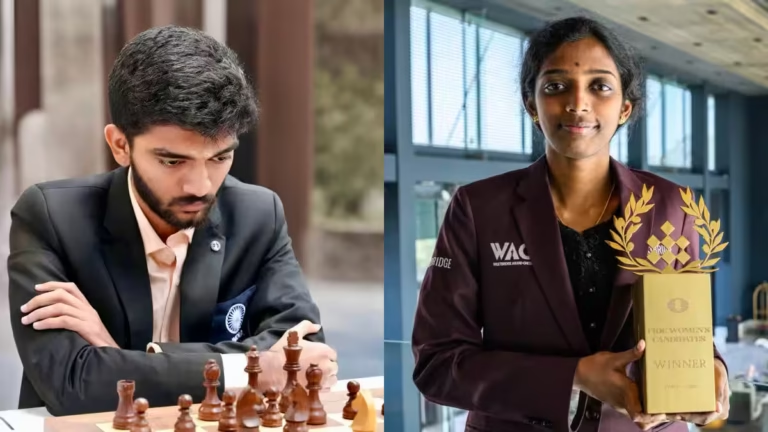
1. The Calm Storm: Gukesh’s Unshakable Composure
When D Gukesh became the youngest Indian to breach elite rating barriers, the chess world knew it was witnessing something extraordinary. But what truly sets him apart is his unwavering composure. Even at the highest levels, Gukesh rarely betrays emotion—which is why the chess community was stunned when he celebrated emotionally after defeating Uzbekistan’s Javokhir Sindarov in the Grand Chess Tour Rapid & Blitz event.
This rare display of emotion was perfectly timed. Modern chess is brutally competitive, with players like Sindarov, Abdusattorov, Praggnanandhaa, Erigaisi, and Firouzja pushing preparation to 25 moves deep. In the 2026 Candidates cycle, Sindarov delivered one of the greatest performances in modern history, scoring a record 10/14. Every classical game now feels like a battle between engines, nerves, and preparation. Yet Gukesh continues to thrive in this chaos.
2. A New Kind of Champion: Gukesh’s Fearless Style
Historically, world champions dominated through signature strengths:
- Magnus Carlsen suffocated opponents in endgames.
- Garry Kasparov overwhelmed them dynamically.
- Viswanathan Anand excelled in speed and opening preparation.
Gukesh defies easy categorization. His games often look uncomfortable, chaotic, even risky—until the evaluation bar suddenly swings in his favor. Analysts highlight his:
✔ Incredible calculation depth
✔ Fearless middlegame decisions
✔ Ability to fight in unclear positions
This style is reshaping Indian chess. Across academies, young players are becoming more tactically ambitious, seeking initiative, activity, and pressure over safety. The “Gukesh generation” plays sharper, more aggressive chess.
3. From Individual Talent to Systemic Success
Producing one world-class player could be luck. Producing an entire generation is a system. Today, India boasts:
✔Multiple 2700+ rated players
✔Olympiad gold medals
✔Elite coaches and structured academies
✔One of the world’s largest youth chess populations
The impact is everywhere:
🔹 More school chess programs
🔹 Increased parental investment in coaching
🔹 Growing female participation
🔹 World-class preparation happening within India
A decade ago, Indian players often needed to move abroad for elite training. Today, the world is studying India.
4. Vaishali’s Historic Rise: No Longer “Pragg’s Sister”
For years, R Vaishali was introduced as “Praggnanandhaa’s sister.” In 2026, that label finally died. Her victory at the Women’s Candidates Tournament wasn’t just another Indian success—it was a watershed moment in Indian women’s chess history. She became the first Indian woman to win the Candidates under the modern format, earning the right to challenge reigning champion Ju Wenjun for the Women’s World Championship.
5. A Tournament Forged in Resilience
Vaishali’s path to victory was far from smooth. She lost momentum. She recovered. She fought under immense pressure. Even her longtime coach, RB Ramesh, admitted that confidence had always been her greatest struggle.
Yet, in the final round against Kateryna Lagno—one of the most experienced players in women’s chess—Vaishali delivered. Analysts praised her calmness in time trouble and the precision of moves like Rd8 and c4, which viewers described as world-class decisions under pressure. The chess world took notice. So did India.
6. Why Vaishali’s Success Matters
For Indian girls entering chess today, Vaishali represents possibility. While legends like Koneru Humpy and Harika Dronavalli paved the way, Vaishali’s generation offers something new: visibility. Young girls now watch relatable players from Chennai, Hyderabad, and Mumbai competing against the world’s best. This visibility changes ambition entirely, proving that world-class success is within reach.
Conclusion
The biggest transformation in Indian chess isn’t about ratings—it’s about belief. Children across India now genuinely believe they can:
✔ Become Grandmasters
✔ Compete internationally
✔ Win world championships
This mindset shift may be the greatest contribution of players like Gukesh and Vaishali. Somewhere in a classroom in Bangalore or Chennai, another future champion is probably replaying their games move by move. The revolution they’ve sparked is more than individual achievements—it’s proof that Indian chess belongs at the very top.
Join the Revolution
Following Gukesh and Vaishali’s journey is a masterclass in modern chess. By studying their historic games, learning from their fearless decisions, and adopting their never-give-up attitude, you’ll develop champion-level skills. Remember, every game is a chance to grow and contribute to India’s chess legacy.
Ready to join the revolution? Visit Young Grandmasters Chess Academy for expert coaching, personalized lessons, and a community of passionate players. Start your chess journey with us today, Contact us and be part of India’s rising chess story!